This summer we covered two court doors closing on empty-rates schemes: the Court of Appeal in 48th Street on occupation, and the High Court in A&P68 v Bradford on who counts as the owner. This piece is the third door, and it is not a court. It is a council that can take the lease.
In February we asked whether the Vacant Properties Bill could force open empty units. That was a private member’s bill. High Street Rental Auctions are already law. They sit in Part 10 of the Levelling-up and Regeneration Act 2023, with the process set out in the 2024 Regulations, and they have been usable in England since 2 December 2024. Thanet has now used them far enough to serve final letting notices. That is the story this week.
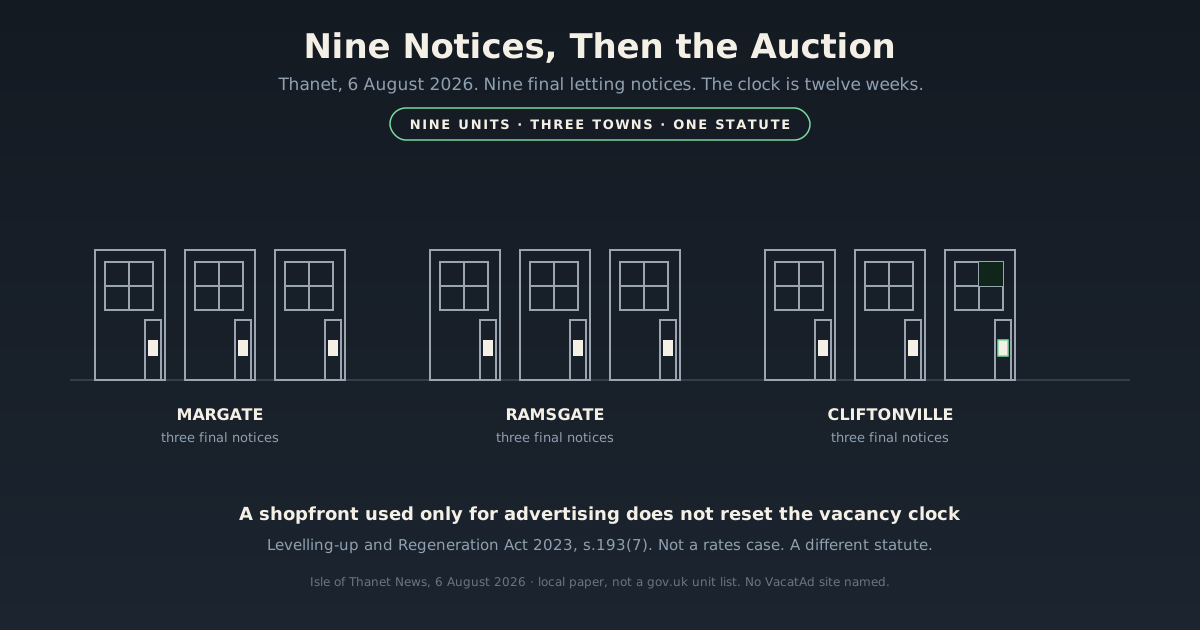
What just happened
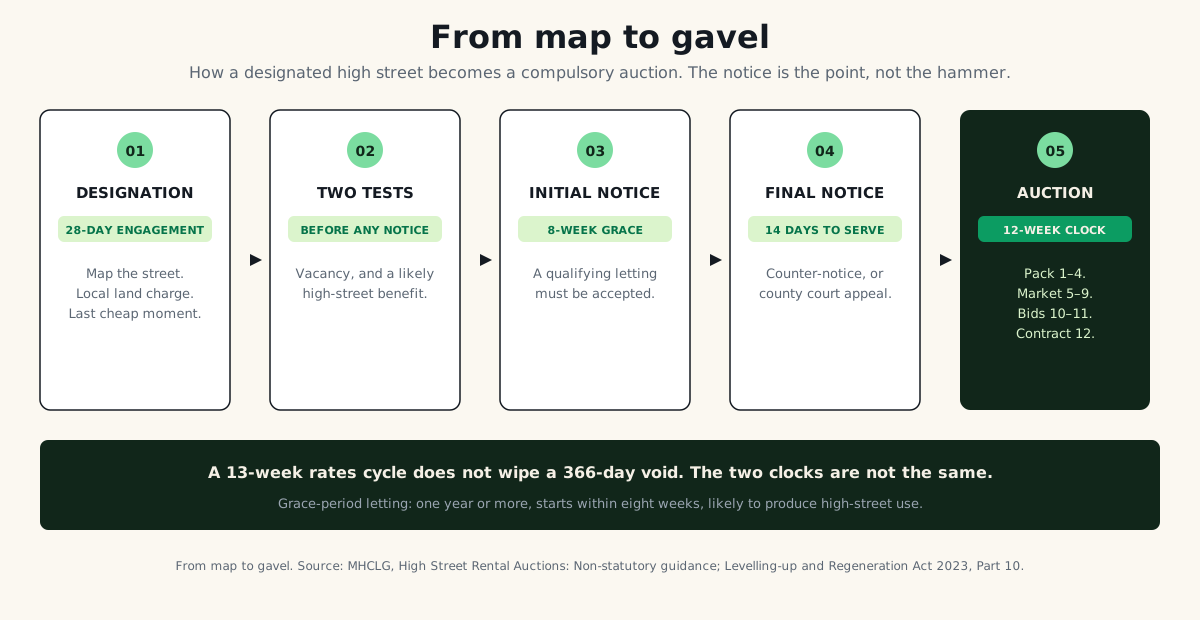
On 6 August 2026, The Isle of Thanet News reported that Thanet District Council had issued formal statutory notices on nine vacant commercial properties: three each in Margate, Ramsgate and Cliftonville. The landlords had already had the eight-week grace period that follows an initial notice. The council then had two weeks to serve a final letting notice. Once that notice is served, the auction clock starts: twelve weeks. Weeks 1 to 4 build the auction pack. Marketing must start as soon as reasonably practicable in week 5 and run for at least five weeks. Bidding sits in weeks 10 to 11. The tenancy contract is expected by week 12. Leases, if granted, run from one year to five.
Thanet’s designated streets are public. Margate covers Cecil Square, Hawley Street, Herbert Place, High Street, Lombard Street, Marine Drive, Marine Gardens, Marine Terrace, Market Street, New Drive, Queen Street, The Centre and The Parade. Cliftonville is Northdown Road. Ramsgate covers Harbour Parade, Harbour Street, High Street, King Street, Queen Street and York Street. Cabinet designated those areas on 18 December 2025. The designations took effect on 6 January 2026.
The council has not published a unit-by-unit list in that report, and we will not invent addresses. It has said it expects some or all of the nine landlords to find tenants themselves. That is how the power is meant to work: the notice is often the point, not the gavel.
A fortnight earlier, Ipswich Borough Council put the same statute on its Executive agenda. A 13 July 2026 council newsroom piece said the Executive would consider, on 14 July, a proposal to consult on designating a town-centre area for High Street Rental Auctions. A 2025 survey of Ipswich’s Central Shopping Area found 19% of units not in use. Designation needs a minimum 28-day community engagement. Ipswich is not running auctions. It is deciding whether to draw the map.
Two different stages of the same tool. One council at final notice. One still at the designation vote.
The ratio, in one sentence: High Street Rental Auctions are already in use. A designated shop that has been empty long enough can be put to a compulsory auction. The notice is often the point, not the hammer.
How the power actually works
The process is slower than the headlines, and more tightly drawn.
The local authority first designates a high street or town centre. The street has to matter to the local economy because of a concentration of high-street uses: shops and offices, services that visiting members of the public use, food and drink, entertainment, communal halls, and light industrial uses that can sit beside those. An industrial estate that mainly trades business-to-business is outside the map. The designation is a local land charge, and the council must keep a public list and a map.
Only then can it look at a particular unit. Before an initial letting notice, it must be satisfied of two statutory conditions.
The vacancy condition (section 193 of the 2023 Act) is met on a given day if the premises are unoccupied that day, and either they were unoccupied for the whole of the previous year, or they were unoccupied on at least 366 days in the previous two years. Days before the section came into force still count. A day on which occupation starts or ends counts as occupied. Living in a unit that is not designed or adapted for residential use does not count as occupation.
The local benefit condition is met if the authority considers that occupation for a suitable high-street use would benefit the local economy, society or environment. That is a wide discretion. The non-statutory MHCLG guidance tells councils to write the reasons down.
If both conditions are met, the council serves an initial letting notice. The landlord then has eight weeks to grant a tenancy or licence with the council’s consent. The council must consent if the letting starts within those eight weeks, is for a year or more (a landlord break in year one is treated as less than a year), and is likely to lead to occupation for a high-street use. A letting in that window without consent is void. The notice is a local land charge, and the guidance tells councils to put a restriction on the landlord’s title at HM Land Registry.
Miss the eight weeks, and the council has fourteen days to serve a final letting notice. After that, any further letting is at the council’s discretion. Works to the premises also need written consent, with a criminal offence (a fine up to level 4, currently £2,500) for carrying them out without it, except urgent repair. The landlord can serve a counter-notice within fourteen days and, if the council does not withdraw, appeal to the county court within twenty-eight days. The grounds include: the vacancy condition was not met on the day of the initial notice; the unit is not reasonably suitable for the stated high-street use; no reasonable authority could have found local benefit; the council wrongly refused a qualifying letting; the landlord intends substantial construction that needs vacant possession; or the landlord intends to occupy for their own business, or as a residence.
If the final notice stands, a twelve-week auction period follows. Weeks 1 to 4 build the auction pack. Marketing must start as soon as reasonably practicable in week 5 and run for at least five weeks, on the council’s website and on a leading commercial-to-let site. The landlord picks the successful valid bid. If they do not pick, the council must take the highest practicable rent. The local authority can enter the tenancy contract in its own name so as to bind the landlord. The landlord may have to bring the unit up to a published Minimum Standard: safe, secure, weathertight, with working doors, fire precautions, and utilities capable of reconnection.
The official guidance says the whole process, from initiation to completion, is expected to take 22 to 24 weeks. It is a permissive power. It is not compulsory purchase. It is also not a paper threat once a council has designated streets and started serving notices.
The vacancy test that actually matters
This is the paragraph that owners of empty shops should read twice.
Section 193(7) of the 2023 Act is not a rating case. It is a definition written to stop a thin presence from resetting the clock:
A state of affairs does not amount to the occupation of premises for the purposes of this section unless it involves the use of the premises for activity that (a) is substantial, (b) is sustained, and (c) involves the regular presence of people at the premises.
MHCLG’s non-statutory guidance repeats that line in almost the same words. Occupation, for High Street Rental Auctions, “must amount to activity that is substantial, sustained, and involves the regular presence of people.” The glossary in the same document describes vacant premises as properties that “do not have a tenant in place and/or are not currently operational as businesses.”
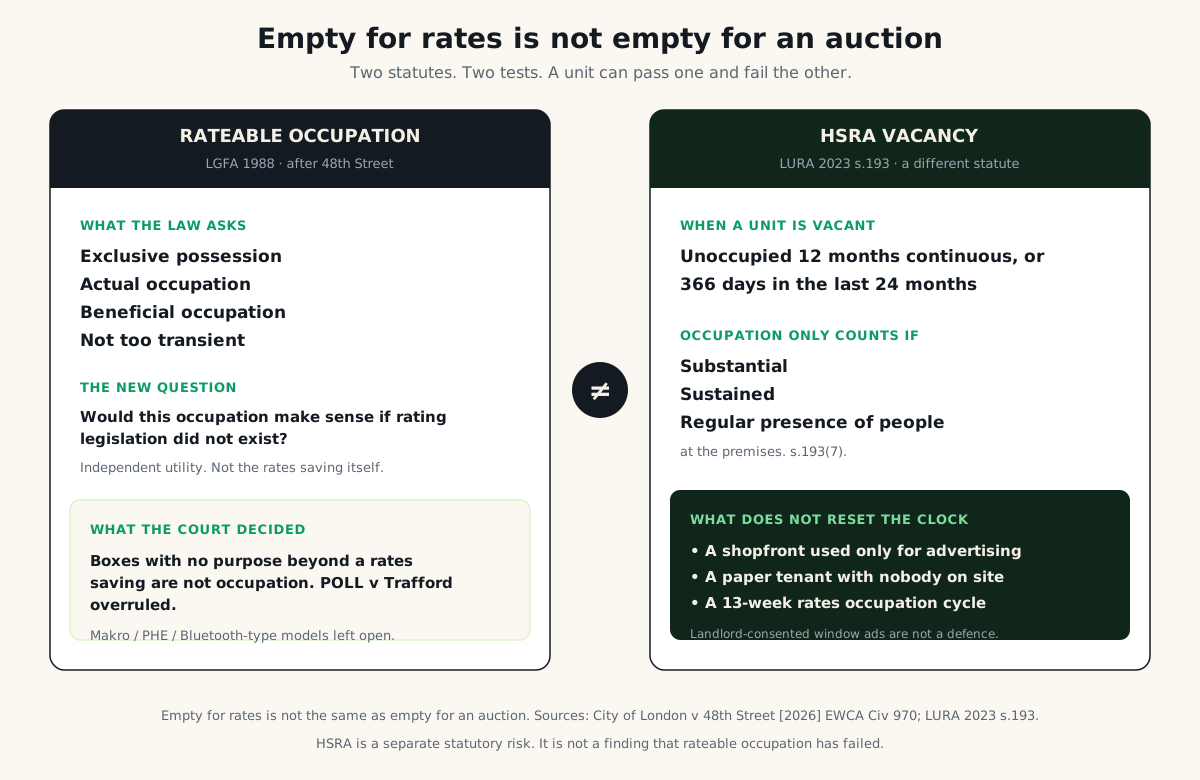
That is a different question from the one the Court of Appeal answered in City of London v 48th Street [2026] EWCA Civ 970. 48th Street asked whether boxes left in a void solely to reset the three-month empty-property exemption were rateable occupation. The Court of Appeal said no. Use whose only point is a rates saving is not occupation. POLL v Trafford was overruled. The court decided the “pure rate-mitigation” case. It left Makro and PHE open. An application for permission to appeal 48th Street to the Supreme Court has been lodged. Until leave is decided, the Court of Appeal remains the live line.
High Street Rental Auctions do not care whether your use has independent utility for rating purposes. They care whether people are regularly in the building, doing something substantial, for a sustained period. A landlord-consented window wrap, a banner, or a unit used only as an advertising surface, with no regular human presence, does not meet section 193(7). Marketing the unit “to let” does not stop the clock either. The guidance is explicit that councils may treat marketing agents as a source of vacancy evidence, not as proof of occupation.
A short pop-up of a few weeks will not wipe a 366-day void. The two-year limb is there precisely so intermittent use does not wash the slate. The one-year continuous limb is even simpler: if the unit has been empty for a full year ending the day before the notice, it qualifies.
So a unit can be in rateable occupation for empty-rates purposes and still fail the HSRA vacancy test, or the other way around. Do not run the two tests as if they were one.
What a notice does to your next letting
Once the initial notice is on the title, you cannot quietly let the unit to a friendly occupier to kill the process. The letting needs the council’s consent. During the grace period they must give it if the term is a year or more, starts inside eight weeks, and is likely to produce high-street use. After the final notice, they do not have to.
That last point matters for anyone offering a short occupation cycle. A 13-week occupation that is designed to reset empty-rates relief is not a letting the council must accept. It is also a poor answer to a statute that is looking for a year of high-street use. If your current mitigation depends on a short licence, a guardian arrangement, or a special-purpose tenant who never trades from the shop, assume the regeneration team will read it against section 193(7), not against your rates file.
The landlord’s appeal rights are real. Vacancy not met is ground one. Intending to occupy for your own business is ground six. Substantial works that need vacant possession are ground five. Those are evidence questions. A planning consent in a drawer, or a rates scheme on headed paper, will not carry them.
How this sits beside 48th Street and A&P68
Read the three together and the empty-unit playbook has had a year of narrowing.
Occupation schemes that exist only to manufacture the four limbs of rateable occupation lost in 48th Street. Boxes with no commercial purpose beyond the rates saving are not occupation.
Ownership schemes that park liability on an SPV with no real ability to occupy lost in Rossendale, Emeraldshaw and A&P68. Paper leases do not move the “owner”.
High-street vacancy is now a third track. A designated shop that has been empty for a year can be put to auction even if the landlord is “doing something” that would never survive a council inspection: a dark interior, a vinyl on the glass, no people, no trade. The statute was written to ignore that.
None of this is a finding that advertising, WiFi, or any other commercial service is or is not rateable occupation. 48th Street decided the boxes case. It did not decide every other model. High Street Rental Auctions do not decide the rates question either. They ask a different, and in one respect harder, question: are people regularly there?
What owners should ask now
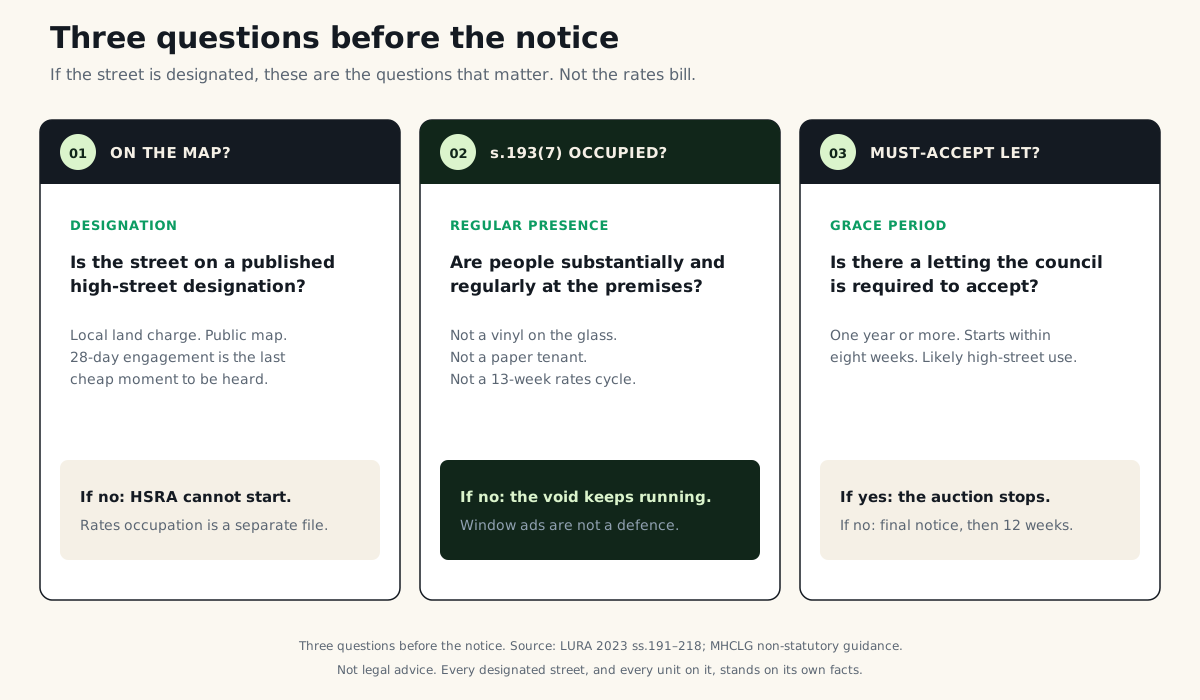
If you hold a vacant shop on a designated high street, or on a street a council is consulting on, three questions are worth putting in writing this week.
- Are we on the map? Designation is public. Thanet’s streets are listed. Ipswich is proposing to consult. Check the council’s HSRA list and map, and treat a 28-day engagement as the last cheap moment to understand the boundary.
- Would section 193(7) treat this unit as occupied? Not “do we have a tenant on paper.” Not “is there a vinyl in the window.” Substantial, sustained activity with the regular presence of people. If the honest answer is no, the vacancy clock is running, and days before December 2024 still count.
- If a notice landed tomorrow, what letting could we complete in eight weeks? It has to start inside the grace period, last a year or more, and be likely to produce high-street use. A rates-only occupation will not be a letting the council must bless.
Our savings calculator will show the empty-rates exposure you are trying to manage. Call 0333 090 0443 if you want a straight answer on whether what you already have would survive both the rating test and the auction test.
The market that remains
None of this is a court endorsement of any particular provider, ours included. It is not a claim that High Street Rental Auctions “uphold” or “kill” a model. They are a regeneration power aimed at long voids on designated streets. Rates relief is a separate statute, with a separate case law.
When VacatAd occupies a unit, we install live advertising and guest WiFi that runs as a commercial service for local businesses, under a formal lease, with router telemetry and service analytics for the full term. That is built to answer the substance questions the courts are asking about occupation. It is not a substitute for a high-street tenant the council can point to on a Tuesday. A shopfront used only as a poster site, with no regular human presence, will not stop an HSRA notice. We would rather be judged on what is happening inside the building than on a claim that any occupation, of any kind, takes the unit off the vacancy register.
After 48th Street, A&P68, and now Thanet’s nine notices, that is where every serious arrangement will be judged.
Source: Levelling-up and Regeneration Act 2023, Part 10, especially s.193 (vacancy condition); Local Authorities (Rental Auctions etc.) (England) and Town and Country Planning (General Permitted Development) (Amendment) Regulations 2024; MHCLG, High Street Rental Auctions: Non-statutory guidance (published 2 December 2024, last updated 5 June 2025). Thanet notices as reported by The Isle of Thanet News, 6 August 2026. Thanet Cabinet designation, 18 December 2025, effective 6 January 2026. Ipswich Borough Council newsroom, 13 July 2026. See also City of London v 48th Street Holdings Ltd & Principled Offsite Logistics Ltd [2026] EWCA Civ 970 and A&P68 Ltd v City of Bradford MDC [2026] EWHC 27 (Admin). The information in this piece is general guidance on UK property and business rates and is not tax, legal or valuation advice.
Ask what a notice would do to this unit
Use the calculator to see your estimated empty-rates exposure on the 2026 list, or talk to us about whether a designated high-street void would survive both the rating test and the auction test.
Try the calculator Get in touch