
Empty commercial property is expensive. Once Empty Property Relief (EPR) expires, owners face the full business rates bill on a building generating zero income. A cottage industry of workaround schemes has grown up to soften that blow. Courts, regulators and Parliament have spent more than a decade picking them apart.
This article surveys the charity, guardian, snail-farm and box-shifting models that keep failing on substance grounds. It also explains why the Court of Appeal's 2026 judgment in City of London v 48th Street closed another door that some providers still marketed as open. It is not a guide to finding the next loophole. Owners who want something defensible in a void are usually better served by live commercial services than by another artificial occupier.
The charity model: how it works (and how it fails)
The mechanism is simple. A charity takes a lease on an empty property, usually at a peppercorn rent. The premises may qualify for mandatory charitable rate relief of 80%, with many councils topping that up to 100% through discretionary relief. The landlord typically pays the charity a fee or premium, funded from the rates savings.
In legitimate cases, a charity genuinely occupies and uses the space. The model has also been systematically exploited. The government's 2024 Business Rates Avoidance and Evasion Consultation confirmed that charity relief is particularly vulnerable to abuse, highlighting cases where owners lease properties to artificial charities used as vehicles to secure exemption.
The Local Government Association (LGA) estimates that business rates avoidance costs councils between £250 million and £300 million per year. Charity-based schemes account for a significant share of that figure.

The Public Safety Charitable Trust
The most notorious case remains The Public Safety Charitable Trust Ltd. This Chester-based organisation leased approximately 2,000 empty commercial premises across 240 local authority areas. Its method involved installing Bluetooth transmitters that broadcast crime-fighting messages to passers-by and offering free Wi-Fi. Landlords paid the Trust a premium from the rates savings they made.
The High Court ruled in May 2013 that the Trust was not entitled to charitable relief, and the Companies Court ordered it wound up shortly afterwards on petitions brought by three local authorities owed substantial unpaid rates. The Charity Commission found the trustees had undermined the meaning of charity. Both former trustees were subsequently banned from holding company directorships, one for nine years.
The Trust enabled businesses to avoid an estimated £17 million in rates. That is £17 million stripped from local authority budgets that fund public services.
The Charity Commission's warning
The Commission has since issued clear guidance that trustees who enter into arrangements with property owners to avoid empty rates will be in breach of their duties. This is not a theoretical risk. Trustees have been disqualified. Charities have been wound up. The government has proposed either removing the "next in use" exemption for charities entirely or removing the exemption altogether.
Kenya Aid Programme v Sheffield City Council
If Public Safety Charitable Trust was the headline-grabbing collapse, Kenya Aid Programme v Sheffield City Council [2013] EWHC 54 (Admin) is the quieter judgment that tightened the whole "a charity is occupying it, so job done" school of thinking. The charity had taken leases on two industrial units at Europa Way in Sheffield and used them to store donated furniture destined for schools in Kenya. When Sheffield chased unpaid rates, the charity claimed the 80% mandatory relief on the basis that the premises were "wholly or mainly used for charitable purposes" under section 43(6) of the Local Government Finance Act 1988.
The High Court disagreed. The district judge had found that no more than 50% of either unit was actually in use. Treacy LJ held that occupation on its own is not enough, and that the magistrates were entitled, and indeed required, to look at the extent of the use as well as its purpose. The case was sent back for reconsideration and Kenya Aid Programme ultimately contributed to a rates bill running to the millions.
The principle that flowed from that judgment is now firmly established. It is not enough to put a charity's name on the door, move a few boxes in, and call it occupation. Councils and courts will look at how much of the building is genuinely in use, and they will treat token or partial occupation exactly as it looks.
Pop-ups and art exhibits
Kenya Aid also undermines a quieter but popular variant: the pop-up shop or short-term art exhibit. An owner invites a pop-up trader or a curator to occupy an otherwise empty unit for a short period, often rent-free or for a nominal fee. Once the occupation is over, a fresh round of Empty Property Relief is claimed on the basis that the building has been reoccupied and the clock reset.
Two problems. First, the 2024 reforms doubled the reset period from six weeks to thirteen. A pop-up calibrated to the old regime now has to run for more than three months to achieve anything, which is often longer than the trader wants or the commercial context permits. Second, Kenya Aid sets a decisive ceiling on what counts as occupation. If a curator hangs a dozen canvases in a 20,000 square foot warehouse, the extent-of-use test bites hard. The same applies to a pop-up that only uses a corner of a much larger unit.
For charity-linked pop-ups the position is worse still. The government's proposed tightening of the "next in use" exemption introduces a minimum six-month period of charitable use before the relief can be claimed on a subsequent vacant period. A fortnight-long art exhibit, however well-intentioned, will not come close.
Property guardians: the hidden risk
Property guardians are often presented as a win-win: the owner gets someone on-site to deter squatters and vandals, the guardian gets cheap accommodation, and business rates liability is supposedly reduced. The reality is considerably messier.
You do not know who you are getting
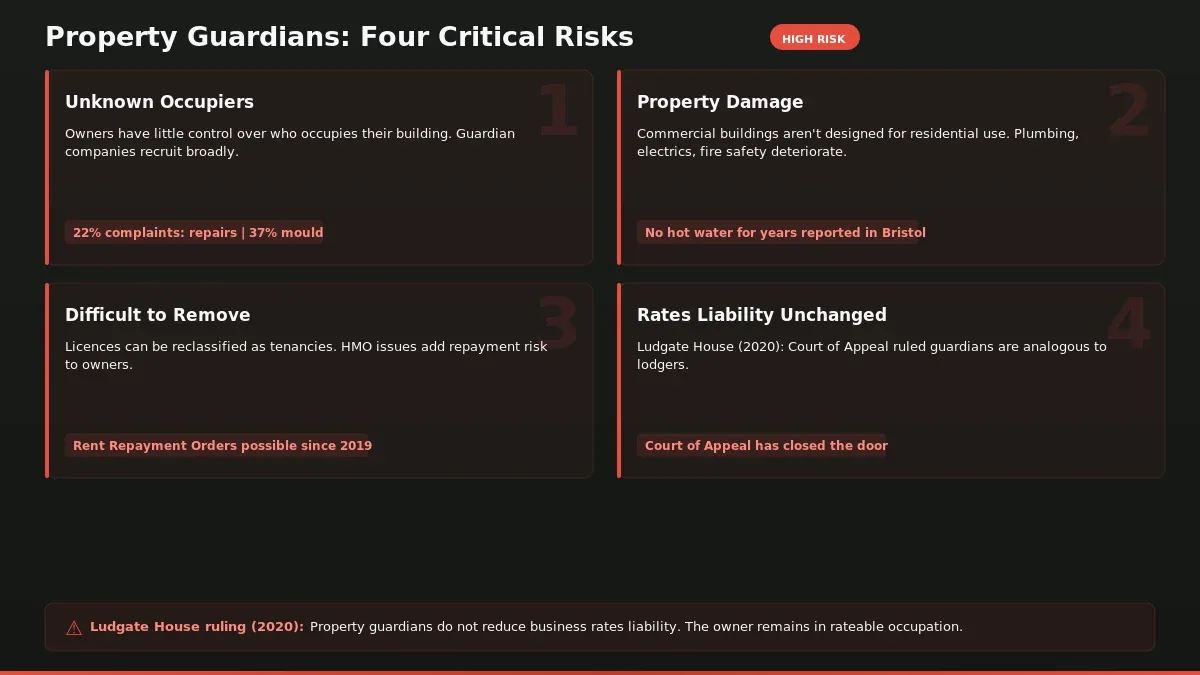
Guardian companies recruit from a broad pool. Guardians are typically students, key workers, or young professionals looking for affordable living. Property owners have little to no say over who occupies their building. The London Assembly's housing committee found that guardian-occupied properties frequently suffer from poor conditions, with 22% of complaints relating to repairs and maintenance and 37% citing mould and condensation. When multiple guardians share a large commercial building, wear and tear escalates quickly, and the owner has limited visibility or control over the day-to-day state of the property.
Wear and tear on commercial property
Commercial buildings are not designed for residential use. Plumbing, electrical systems, fire safety provisions, and internal finishes are all built to commercial specifications. Putting people in them as residents accelerates deterioration. Guardian properties in Bristol have reported years of living with no functioning hot water. In London, properties have been found with wholly inadequate sanitary facilities for the number of occupants.
Licences, not tenancies: the legal contortion
Guardian schemes sit on a careful legal tightrope. In Street v Mountford [1985] AC 809, the House of Lords held that where a person is given exclusive possession of residential accommodation for a term at a rent, a tenancy arises regardless of what the parties choose to call it. Labels do not matter. Substance does.
Guardian companies structure agreements so that guardians share common parts, have no right to a specific room, can be moved at short notice, and perform quasi-security duties for the owner. That preserves flexibility for the owner, but it is also why, under the classic test in LCC v Wilkins [1957] AC 362, guardians cannot be treated as the rateable occupier. Rateable occupation requires four ingredients: actual, exclusive for the occupier's own purposes, of benefit, and not too transient. Guardians fail the exclusivity limb almost by definition, because the owner deliberately retains overarching control.
That internal contradiction is what Southwark LBC v Ludgate House Ltd [2020] EWCA Civ 1637 finally resolved. The Court of Appeal found the guardians were performing a security function for the owner's benefit and that the owner retained "general control" of the building. The owner, not the guardians, was the rateable occupier.
Difficult to remove
Even under a licence, removal is not always quick. If a guardian occupies a specific room with a lock, pays regular fees, and has been there for an extended period, a court may find they have tenancy rights. If the building qualifies as a House in Multiple Occupation (HMO) without proper licensing, guardians can apply for a Rent Repayment Order. Suddenly the savings from avoided rates are dwarfed by repayment claims.
Ludgate House: the door is closed for rates purposes
For property owners using guardians primarily to reduce empty rates, the Court of Appeal has effectively closed the door. Guardians are treated as lodgers or service occupiers, the owner retains general control, and the rates liability stays exactly where it was.
The rest of the rogues' gallery
Snail farms
Snail farms involve placing sealed crates containing a handful of snails inside a vacant commercial building and claiming agricultural exemption from rates. Westminster City Council has taken legal action against multiple snail farm operations, reporting losses of around £370,000. In Liverpool, council investigators found just 15 covered crates, some containing as few as two snails each, on the lower ground floor of 9 Dale Street (Local Government Lawyer). The leading authority for treating these arrangements as shams is Isle Investments Ltd v Leeds City Council [2021] EWHC 345 (Admin), in which Kerr J ignored the contracts as shams and held the landlord to remain the rateable occupier.
Box shifting
Box shifting cycles token goods in and out of properties to repeatedly trigger EPR resets. For years, Principled Offsite Logistics v Trafford Council was cited as authority that motive did not matter if boxes were physically present. The End Rates Avoidance campaign, backed by around 100 councillors and MPs, estimates the practice costs councils £250 million annually.
That citation is now dangerous. In City of London v 48th Street Holdings Ltd [2026] EWCA Civ 970, the Court of Appeal overruled POLL v Trafford, reversed the May 2025 High Court decision that had upheld the scheme, and held that "pure rate mitigation occupation" with no independent commercial utility is not occupation at all. Providers still selling box cycles on the back of the old case law are selling outdated authority. Read our full analysis in The Day the Boxes Lost.
Government is tightening the screws
The direction of travel from government is unmistakable. The 2024 consultation response delivered several concrete reforms and signalled more to come.
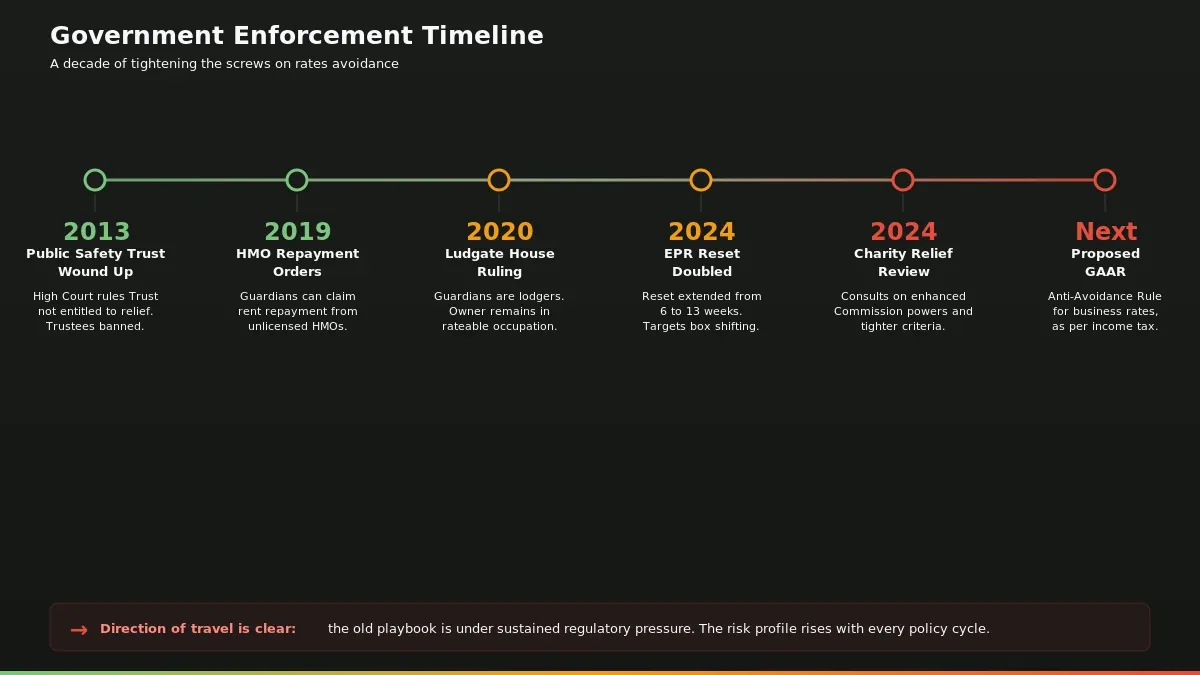
EPR reset period doubled. From April 2024, the reset period extended from six weeks to thirteen weeks, directly targeting short-cycle occupation schemes.
Charity relief under review. The government has explored granting the Charity Commission enhanced enforcement powers, tightening eligibility criteria, and defining occupation by percentage of floor space actually utilised.
A General Anti-Avoidance Rule. A further consultation has been announced on introducing a General Anti-Avoidance Rule (GAAR) for business rates in England, mirroring the approach already used in income tax and corporation tax.
What a live commercial service looks like (and how it differs)
Owners still need voids managed between tenants. That is a property and revenue question first. Empty rates are a tax consequence that may follow from how the void is used, not a product category in its own right.
VacatAd provides three connected services in empty units:
- Connect: guest WiFi and portal access for visitors and passers-by.
- Advertise: window and digital display inventory promoting local businesses.
- Protect: remote monitoring and alerting while the unit is unlet.
Those services run as a commercial operation from the premises. They do not depend on charitable status, guardian licences, agricultural exemptions, or cycling boxes whose only purpose is a rates reset. Where occupation lawfully follows from operating that business, EPR may reset as a secondary outcome. VacatAd does not guarantee relief and does not market itself as a "mitigation scheme".
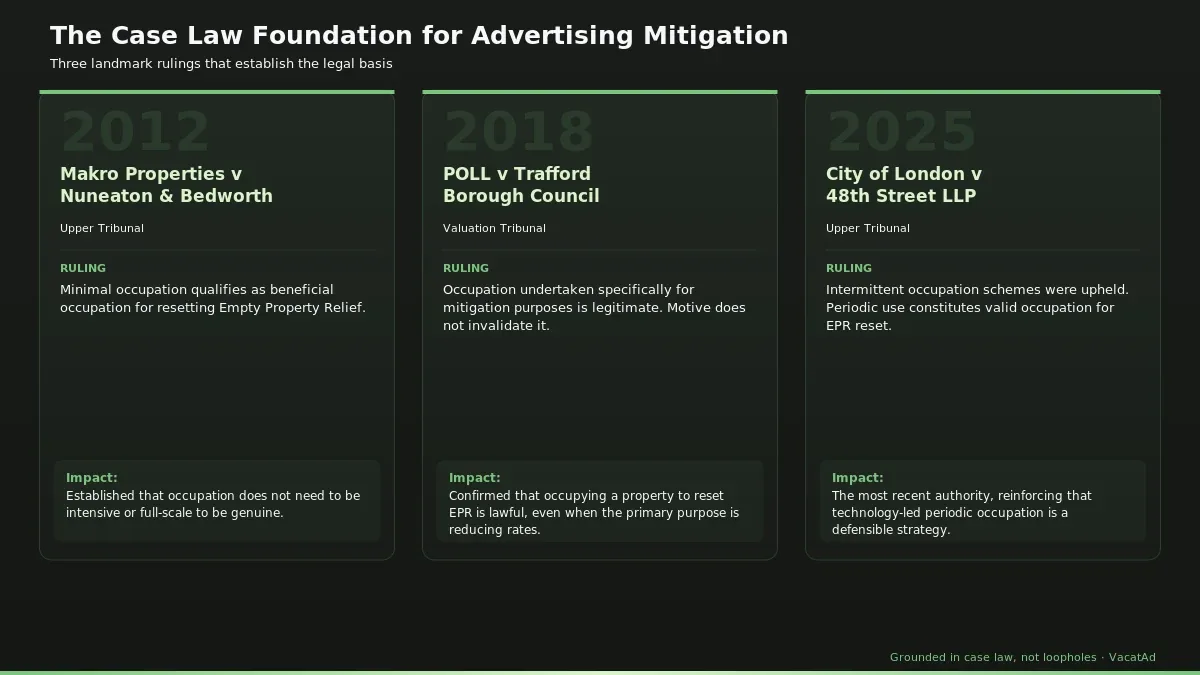
The legal picture is narrower than many sales decks suggest. Makro v Nuneaton (2012) involved storing records the occupier was legally required to keep, not worthless boxes placed only to reset relief. POLL v Trafford supported pure box shifting until the Court of Appeal overruled it in July 2026. Sunderland v Stirling Investment Properties (2013), where active broadcasting equipment in a warehouse constituted occupation, was cited without criticism in the 48th Street appeal as a different arrangement with real service delivery.
The useful question after 48th Street is the one the Court of Appeal posed in substance: would the activity in the building make commercial sense if rating legislation did not exist? Guest connectivity and local advertising do. Token snails, sham charities and pure box cycles do not.
Why the difference matters
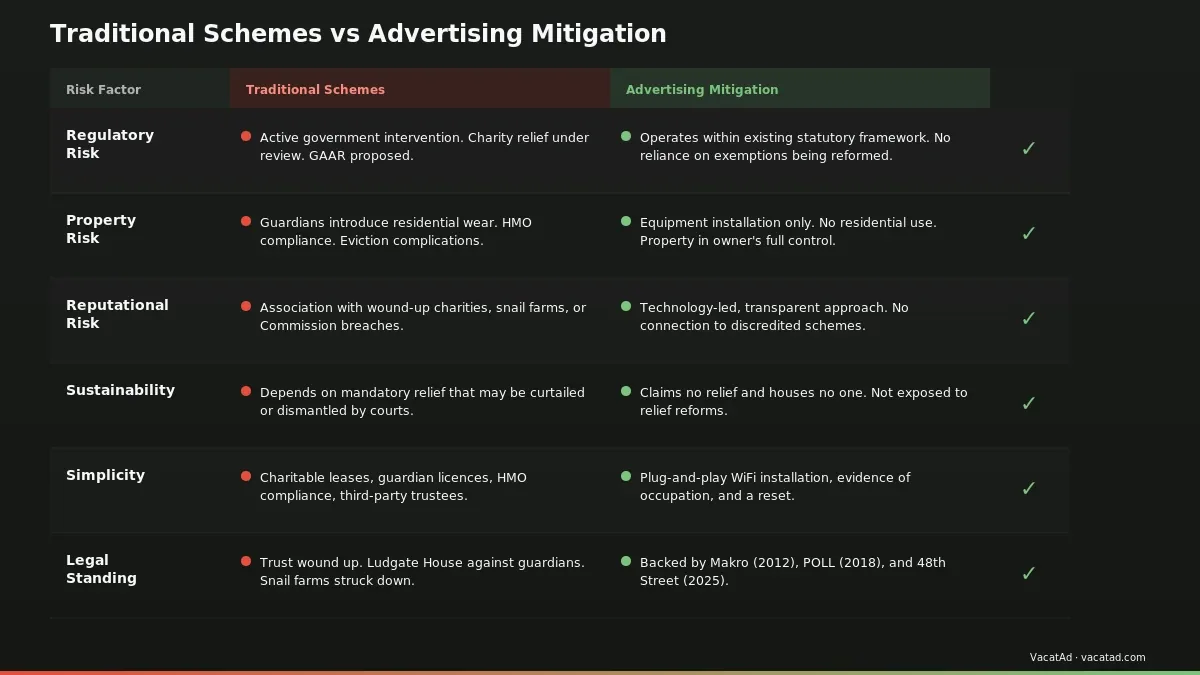
Regulatory risk. Charity schemes face active government intervention. Guardian schemes were undermined by Ludgate House. Box shifting lost its leading authority in 2026. Live commercial services are judged on whether the business is real, not on whether an exemption was gamed.
Property risk. Guardians introduce wear and tear, HMO compliance obligations, and eviction complications. Equipment-based services do not house residents in a commercial shell.
Reputational risk. Being associated with a scheme the Charity Commission describes as undermining the meaning of charity, or with a snail farm raided by investigators, is not a good look for institutional landlords. Running local connectivity and advertising is a different conversation with councils and stakeholders.
Simplicity. No charitable leases, no guardian licences, no agricultural fiction. Install, operate, document, and relett when a tenant appears.
The bottom line
The traditional playbook was built on borrowed time. Charities wound up by the courts, guardians rejected by the Court of Appeal, snail farms treated as shams, and box shifting overruled in 2026: the pattern is the same. Schemes that rely on artifice or exemption gaming keep failing on substance.
Property owners still face empty rates pressure, but the answer is not necessarily another artificial occupier. Live Connect, Advertise and Protect services address the void itself. Rates may fall where occupation genuinely follows from that activity. That is for your advisers and the billing authority to determine, not something VacatAd promises on a slide deck.
Connect, Advertise, Protect in your voids
Guest WiFi, local advertising and remote monitoring for empty commercial units. Ask us how the service works; empty rates are a separate legal question.
WiFi Services Local Advertising Contact Us