In April we wrote about why traditional rate mitigation is failing: charities wound up by the courts, guardian schemes dismantled by the Court of Appeal, and snail farms raided by council investigators. We said the reform debate was heating up. Three months on, it has moved onto one of the most expensive shopping streets in the world.
Since that piece went out, the campaign to tighten Empty Property Relief has opened a public installation in Mayfair, its parliamentary letter has reached 100 MP and councillor signatories, Wales has pressed ahead with its own anti-avoidance framework, and the one thing everyone is actually waiting for, the government’s response to its February call for evidence, still has not appeared.
Where things stand in July 2026
- The ERA campaign is loud and public. “The House of Fakes” opened on New Bond Street on 19 June; the open letter has 100 MP and councillor signatories.
- Whitehall is silent. HM Treasury’s call for evidence closed on 18 February. Nearly five months later, there is no published response.
- Wales is moving. Cardiff has legislated for a general anti-avoidance framework and consulted on regulations defining artificial arrangements.
- The law has not moved. Every rule that applied to your empty building in January applies today.
The campaign goes public
On 19 June, ASTOP, the charity-occupation provider behind the End Rates Avoidance (ERA) campaign, opened “The House of Fakes” on New Bond Street. Created with the charity Datio, it is a walk-through installation dramatising the avoidance tactics that have given this industry a bad name: box shifting, snail farms and fake places of worship. At the launch, ASTOP founder Shaylesh Patel repeated the campaign’s central demand, extending the occupation period needed to reset Empty Property Relief from thirteen weeks to six months.
Credit where it is due: it is a clever piece of campaigning, and much of what is inside that installation deserves the ridicule. We made the same case in our cautionary tale about snail farms last autumn, and we have consistently argued that sham arrangements corrode trust in legitimate mitigation. On the fakes, we and the ERA campaign are on the same side.
A declaration of interest (theirs and ours)
Read every provider’s recommendations with their stake declared
One fact is worth knowing when you weigh the campaign’s manifesto. ASTOP is not only the campaigner; it is also a provider. Its business is charity-partnership occupation of empty property, and the House of Fakes presents that model as the ethical alternative to the tactics on display. The campaign’s proposed fix and the campaigner’s commercial product are the same thing.
That does not make the campaign wrong, but it does mean its recommendations should be read the way you would read ours: as the view of a business with a stake in the outcome. We are a mitigation provider too, and our interest is exactly as declarable. The difference is in what each of us thinks the test for genuine occupation should be, and that difference is where the whole reform debate now sits.
The manifesto, point by point
The ERA manifesto makes six demands, and its open letter had reached 100 MP and councillor signatories by early July. Here is where we stand on each.

AgreeClosing the “snail sham”. Sealed crates of snails in an empty office are not agriculture. Courts have repeatedly said so. Codifying that in statute costs legitimate operators nothing.
AgreeClosing the fake places of worship loophole. Same logic. If occupation is staged, it should fail, whatever label is on the door.
CautionDiscretionary council powers. Councils already defeat sham schemes when they bring evidence, as Westminster’s snail farm wind-ups showed. Broad discretion, by contrast, risks a postcode lottery in which identical occupation is accepted in one borough and rejected in the next. Wales has chosen to define artificial arrangements in regulation instead, which is at least predictable.
ContestA one-year limit on “avoidance”. A time limit on lawful mitigation is a blunt instrument. It does not distinguish a staged scheme from a genuinely occupied building, and it penalises owners in weak markets where voids simply last longer than a year.
ContestA six-month reset trigger. This is the big one, and we come back to it below.
ContestPromoting charity-partnered mitigation. This is the point where the campaign and the product merge. Recall that the government’s own 2024 avoidance consultation found charity relief “particularly vulnerable to abuse”, and that the most notorious mitigation collapse in the sector’s history, the Public Safety Charitable Trust, was a charity scheme. There are good charity occupiers doing real work in real buildings. But building national policy around the campaigner’s own model, in the same breath as condemning everyone else’s, deserves more scrutiny than it has had.
Meanwhile, in Whitehall: silence
All of this campaigning is aimed at a process that has stalled. HM Treasury’s Business Rates and Investment call for evidence, which covers the Empty Property Relief reset period and avoidance directly, closed on 18 February 2026. Nearly five months later there is no published response and no date for one.
Since the call for evidence closed on 18 February 2026, with no published government response and no date announced.

The submissions made to it show what is on the table. The Local Government Association asked for the reset trigger to rise from thirteen weeks to six months, a cap on how many times relief can be claimed, and removal of the “next in use” charity exemption, and it pressed the government to publish the long-promised consultation on a General Anti-Avoidance Rule (GAAR) for business rates in England. That GAAR consultation also remains unpublished.
So the position for England is: maximum noise, zero movement. Every rule that applied to your empty building in January applies today.
Wales shows where this could go
England’s silence looks louder next to Cardiff. The Welsh Government has legislated for a general anti-avoidance framework and consulted on regulations defining “artificial avoidance arrangements”, with implementation timetabled for April 2026 subject to Senedd approval, alongside a new duty on ratepayers to report changes of circumstances. Scotland has had statutory anti-avoidance powers since 2020.
The Welsh approach matters because of how it draws the line. Rather than banning mitigation or stretching time periods, it attempts to define what makes an arrangement artificial: occupation not on a commercial basis, contrived characteristics, and so on. Substance, not stopwatch. Whatever an English GAAR eventually looks like, Wales is the template on the shelf.
The law has not moved an inch
While the campaign escalates, the legal position remains exactly where the High Court left it in May 2025. In City of London v 48th Street Holding Ltd and Principled Offsite Logistics Ltd, the court dismissed a £111,475 claim and confirmed that occupation whose value to the occupier is the occupation itself is genuine rateable occupation, capable of resetting Empty Property Relief. No appeal has been reported. We covered the ruling and its implications when it was handed down.
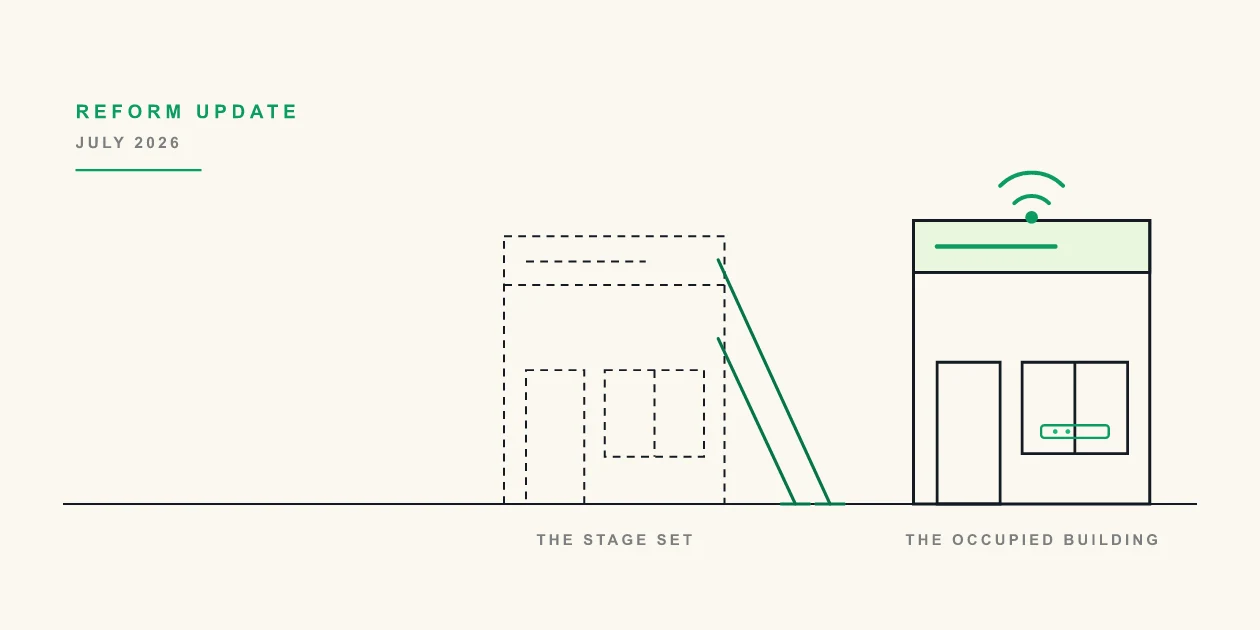
What the courts keep punishing is artifice, not mitigation. Put that next to Makro v Nuneaton (2012) on minimal occupation and POLL v Trafford (2018) on occupation undertaken for mitigation purposes, and the line is consistent: real occupation counts, staged occupation does not. The House of Fakes is full of the former. It contains nothing that looks like a WiFi-connected building genuinely in use.
What a six-month trigger would actually mean
The campaign’s flagship ask, doubling the reset period from thirteen weeks to six months, is the one that would most change the economics of vacancy, so it is worth being concrete.

Today, a genuine occupier must sustain thirteen weeks of occupation to unlock a fresh relief window of three months (six for qualifying industrial property). Under the ERA proposal, the qualifying occupation roughly doubles to twenty-six weeks while the relief it unlocks stays the same. For the owner of a vacant unit with a rateable value of £100,000, the exposure on the other side of that equation is £48,000 a year at the 2026/27 standard multiplier of 48.0p, and £304,800 a year for a £600,000 RV warehouse on the 50.8p higher multiplier, figures we unpacked in our piece on the 2026 revaluation squeeze.
Here is the inconvenient part for the campaign: a longer stopwatch does not filter fakes. The 2024 extension from six weeks to thirteen was aimed squarely at box shifting, and the sham operators simply adapted while compliant occupiers absorbed the extra cost. Doubling the period again would repeat that pattern at twice the scale. It is the owners running genuine occupation, and the councils hoping vacant space returns to productive use, who pay for the blunt instrument.
Test substance, not stopwatches
Our submission to MHCLG and the Valuation Office argued for a different fix: a statutory, substance-based test for genuine occupation. Ask what is actually happening in the building. Is there real equipment, really operating? Is there a service being delivered with an economic purpose? Can the occupier evidence it, continuously, rather than on the day of inspection? If yes, the occupation counts, whoever runs it. If it is staged scenery, it fails, whoever runs it.
A test like that closes the snail farms and the fake chapels overnight, without a postcode lottery and without punishing the models that do exactly what the legislation always intended: putting empty buildings back to use. It is also, not coincidentally, a test our model passes with room to spare, because beneficial occupation through live, evidenced technology is substance by design. We would rather be judged on what is happening inside the building than on how long a stopwatch has been running, and we think the statute should work the same way.
What owners should do now
Nothing about your liability changed this quarter, but the direction of pressure is clear, so three practical steps follow.
First, stress-test your current mitigation against a substance test, because every proposal on the table, from the LGA’s to Wales’s to ours, converges on scrutiny of what is really happening in the building. If your provider cannot show continuous, independent evidence of genuine use, the arrangement is exposed under the current rules, never mind the next ones.
Second, be sceptical of anyone selling certainty about reform, in either direction. The government response could land any week and could adopt the six-month trigger, a GAAR, a substance test, or none of the above.
Third, price your exposure now rather than after the announcement. Our savings calculator will show you what your empty rates bill looks like under the 2026 list, and what genuine, evidenced occupation would save against it. Or call us on 0333 090 0443 and we will walk the numbers through with you.
The House of Fakes is right about the fakes. The answer to fakery, though, is not a longer stopwatch or a switch to the campaigner’s own product. It is a rulebook that tests substance, and a mitigation market confident enough to be judged on it.
Price Your Exposure Before Reform Lands
Use our free calculator to see your estimated rates bill under the 2026 list, or get in touch for a no-obligation assessment of your property or portfolio.
Try the Calculator Get in Touch