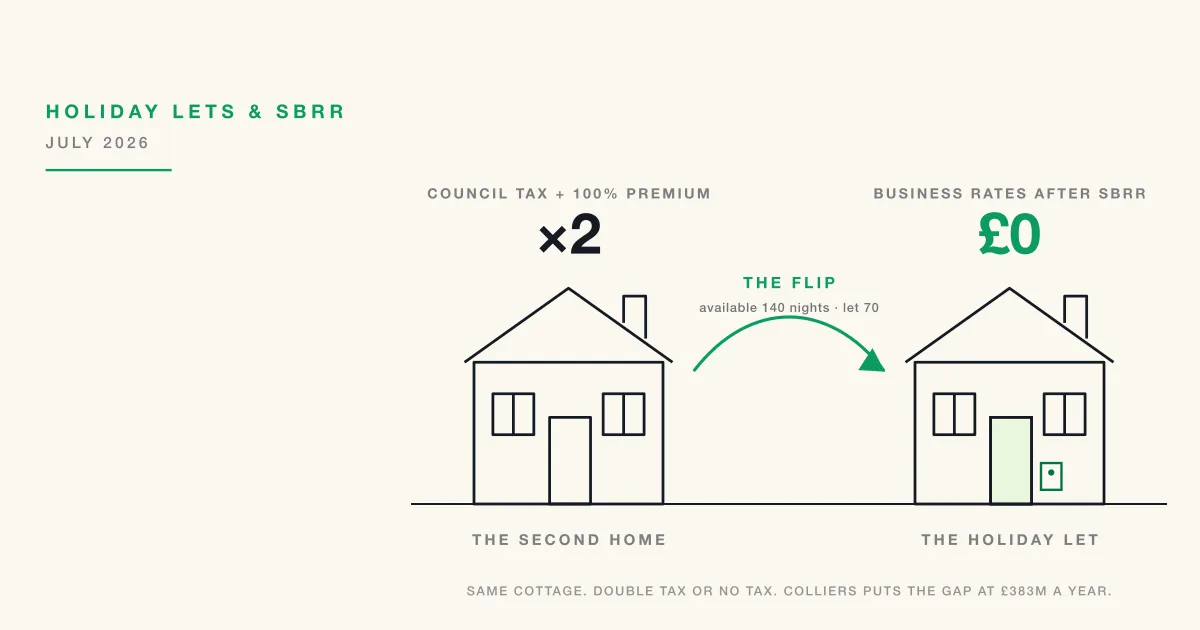
Estates Gazette’s 11 July edition gave fresh legs to a story that has been building all year: research from Colliers finding that around 77,000 holiday-let properties in England and Wales now qualify for 100% business rates relief, and so pay neither business rates nor council tax. Colliers puts the money councils are missing at around £383m a year.
None of this involves an empty shop, office or warehouse. The properties in question are cottages in Cornwall and barns in the Dales, and the relief in question is small business rates relief, not Empty Property Relief. So why are we writing about it?
Because this is now the loudest “rates loophole” story in the press, and the climate it creates does not stay neatly inside the holiday-let sector. When the headlines say avoidance, the political response tends to arrive as a tightening of the whole system. With a new prime minister expected in Downing Street within days, a rates package already sketched out, and the government’s empty-rates reform response five months overdue, the holiday-let row is worth understanding properly, not least because almost everything about it is misdescribed.
The holiday-let gap in three numbers
- 77,241 properties in England and Wales now qualify for 100% small business rates relief as holiday lets (up 4.4% year on year).
- £383m a year is what Colliers estimates councils forgo when those properties pay neither council tax nor business rates.
- Triple in five years: the gap has risen from £110m in 2021, mostly because council tax premiums doubled the prize for flipping, not because property counts tripled.
The mechanism: a flip, not a fiddle
Start with what is actually happening, because “loophole” suggests something hidden, and there is nothing hidden here.

A second home in England can move from the council tax list to the business rates list if it is run as genuine self-catering accommodation: available to let commercially for at least 140 nights a year, and actually let for at least 70. Once it is a non-domestic hereditament, it gets a rateable value. And because most cottages are small, most of those rateable values fall under £12,000, which is the threshold for 100% small business rates relief. Between £12,000 and £15,000 the relief tapers. Wales runs the same structure with a much stiffer entry test: available for 252 nights and actually let for 182.
Follow the chain to its end and the result is striking. The owner stops paying council tax, starts paying business rates, and the business rates bill is zero. Both outcomes are exactly what the rules provide for. Parliament set the letting thresholds, the Valuation Office assesses the rateable value, and small business rates relief does what it was designed to do. Nobody is hiding a snail farm in the spare bedroom.
This is a statutory election between two tax regimes, made on published criteria, with evidence requirements that were deliberately tightened in April 2023. It is the system working as written. Whether the system should be written that way is a fair question, but it is a question for the people who wrote it.
Five years, one tripling
The second thing worth saying is that the numbers have moved dramatically, and the reason they have moved is mostly not the behaviour of owners. It is the behaviour of policy.

Colliers has tracked this for years. In August 2021 it counted just over 73,000 qualifying properties and put the lost council tax at around £110m a year. By 2024/25 the figure was £172m, by 2025/26 it was £334m, and the 2026 research lands at £383m. The gap has more than tripled in five years.
Here is the detail that most of the coverage skips: the number of properties did not triple. It barely moved. The list peaked at 85,044, fell for two years after England introduced its actual-letting test in April 2023, and only turned upwards again this year, rising 4.4% from 73,838 to 77,241. The 2023 tightening did what tightening does: it trimmed the marginal cases and left the genuine letting businesses standing.
What tripled the money was the counterfactual. From April 2025, councils gained the power to charge a premium of up to 100% on second homes, and they used it: 85% of English local authorities and 91% of Welsh ones now charge some level of surcharge. Every premium decision doubles what a flipped property “costs” the council in forgone tax, and, at exactly the same time, doubles the saving on offer for meeting the letting thresholds. The stick meant to discourage second-home ownership became the single best advert for the business rates election.
John Webber, Colliers’ head of business rates, does not mince his words about whose fault that is: “Offering either double taxation or no taxation at all is not a sustainable approach. It distorts behaviour and undermines the ability of local authorities to raise vital funds.” He blames the government, not the owners, and on the mechanics he is right. A system that prices the choice at double or nothing should not act surprised when people choose nothing, particularly when, as Webber points out, the English entry requirement amounts to letting your cottage for ten weeks a year.
Where the gap lives
The geography is as lopsided as you would expect.

Colliers counts 22,970 rate-free holiday lets across Cornwall, Devon, Dorset and Somerset, up from 21,678 last year, and estimates the four counties would raise an additional £119m a year if those properties paid council tax under their current premium policies. Cornwall alone hosts 11,450 of them, at an estimated £59m a year; back in 2021 the same county had 10,701 such properties at an estimated £18m. The property count rose 7%. The money tripled. North Yorkshire, the largest concentration outside the South West, has 5,910 qualifying properties and a gap Colliers puts at £30m.
These are precisely the councils under the most acute service pressure from tourism itself, which is why the story has such staying power in the local and national press, and why it polls so well as an “avoidance” story regardless of what the law actually says.
“Loophole” is doing a lot of work in that sentence
Now to the part that concerns us directly, and the reason a business rates mitigation firm is writing about seaside cottages at all.
Look at what the holiday-let arrangement actually is: a relief applied exactly as designed, on criteria Parliament wrote, tightened twice, and policed by the Valuation Office. The government has spent the last three years legislating around its edges. It tightened the English letting test in 2023, abolished the furnished holiday lettings income-tax regime from April 2025, and is building a national short-term lets register that was targeted for April 2026 and is still being tested. At every step it has left the business rates election itself open. And yet the entire debate is conducted in the language of “loopholes”, a word that quietly reclassifies compliance as wrongdoing.
We have seen this movie before, because our own sector lives inside it.

There is a real spectrum here, and the law draws its lines carefully. At one end sits statutory relief used as designed: small business rates relief on a working holiday cottage, or the three rate-free months every empty shop and office receives automatically (six for industrial). Next to it sits occupation tested in court: genuine, evidenced beneficial occupation that resets Empty Property Relief, the model the High Court upheld in Sunderland v Stirling in 2013 and again in the 48th Street ruling in 2025. Then come the shams, sealed crates of snails and fake places of worship, which courts strike down whenever councils bring the evidence. And at the far end sits evasion, which is simply criminal.
The headlines bundle all four into one word. The law does not, and the difference matters enormously to anyone who owns property. Because when “loophole” becomes the frame, the policy response stops distinguishing between the cottage owner who followed the published rules, the operator running genuine occupation an inspector can walk into, and the box-shifter gaming the reset clock. Everyone gets the same medicine, and the medicine is usually a blunter rule.
Three reasons this lands on empty commercial property
1. Climate
The campaign to tighten Empty Property Relief, which we examined point by point in our July reform update, trades on exactly this framing: keep “rates avoidance” in the news, and reform of some kind starts to feel inevitable even while the government’s own call for evidence response sits unpublished. Every holiday-let headline warms that water. It does not matter that the mechanism is unrelated to empty commercial property; the word “loophole” carries the story across.
2. The incoming government
Andy Burnham, expected to be confirmed as Labour leader on 17 July and prime minister shortly after, has already pledged a rates package: a 20% cut for pubs, clubs and music venues, and a small business rates relief threshold raised from £12,000 to £18,000. Notice what that second measure does to the story above: mechanically, it widens the very gap Colliers is measuring, by pulling every holiday let with a rateable value up to £18,000 into 100% relief. And notice how the package is to be paid for: a levy on large online-retail warehouses, plus measures, still entirely undefined, “targeting the owners of empty high street properties”. A government that widens one relief with one hand will need visible “loophole closing” with the other, and empty property owners are the group already named on the funding line.
3. SBRR is becoming a battleground
The same Estates Gazette edition that revived the Colliers research reports the Valuation Office increasingly assessing serviced-office buildings as single hereditaments, a move that strips small business rates relief from operators suite by suite, with one operator facing a £500,000 backdated bill. Holiday lets stretching the relief at one end, the VOA clawing it back at the other, and an incoming government proposing to enlarge it in the middle: that is a relief heading for a fundamental review. Colliers itself is calling for exactly that. When the review comes, it will not confine itself to cottages.
The same lesson, again: test substance
If there is one thing the holiday-let saga proves, it is that threshold-fiddling does not fix an incentive problem. The 2023 letting test did trim the list, and the money gap tripled anyway, because the premiums policy doubled the prize. The response now gathering support, predictably, is to fiddle the thresholds again.
Our sector is being offered the same prescription. The campaign demand of the moment is to double the Empty Property Relief reset period from thirteen weeks to six months, a stopwatch solution to a substance problem, which we have argued against in detail. A longer clock does not filter fakes; it just raises the cost of compliance for everyone genuine while the determined adapt, which is precisely the pattern the holiday-let numbers trace in miniature.
The better answer, in both worlds, is to test what is actually happening at the property. A cottage that is demonstrably let for 70 nights is a business; the register now being built will make that checkable at national scale, and we think the letting thresholds will end up policed through it. A building with live, evidenced technology genuinely operating inside it is occupied; that is what the four-limb test of rateable occupation has always asked, and it is the test our entire model is built to pass with evidence to spare. Substance-based rules close shams without punishing compliance. Stopwatches and thresholds punish compliance without closing shams.
What owners should do now
If you hold empty commercial property, nothing in this story changes your liability this quarter. The rules that applied to your vacant unit in January, which we set out in Business Rates 101, apply today. But the direction of travel is not subtle: an incoming government with a funding line that names empty property owners, a reform response that could land any week, and a press climate in which every relief is one headline away from being a loophole.
So take the practical steps while the window is calm. Make sure any mitigation you run would survive a substance test, because every serious reform proposal converges on evidence of genuine use, and under the 2026 revaluation the cost of getting this wrong has never been higher. Price your exposure now: our savings calculator will show you what your empty rates bill looks like on the 2026 list and what genuine, evidenced occupation saves against it. Or call us on 0333 090 0443 and we will walk through the numbers with you.
The cottage owners of Cornwall did not break the rates system. They read it. The lesson for everyone else in the system is to make sure that what you are doing reads just as well, because the people rewriting the rulebook are no longer reading carefully.
Price Your Exposure Before the Rulebook Changes
Use our free calculator to see your estimated rates bill under the 2026 list, or get in touch for a no-obligation assessment of your property or portfolio.
Try the Calculator Get in Touch