Earlier this month we wrote that, for all the campaigning noise around empty rates, the law had not moved an inch. On 29 July it moved a mile.
In City of London v 48th Street Holdings Ltd and Principled Offsite Logistics Ltd [2026] EWCA Civ 970, the Court of Appeal allowed the City of London’s appeal against the May 2025 High Court decision that had upheld “box shifting”, the practice of placing boxes of redundant contents in an empty building for six weeks at a time to reset Empty Property Relief. The court did not stop there. It overruled Principled Offsite Logistics v Trafford Council, the 2018 case that had underpinned the pure end of the mitigation market for eight years.
We have read the judgment in full. This piece sets out what the court decided, what it deliberately left standing, and why, as a mitigation provider, we are not sorry to see the boxes go.
What the court decided
The scheme before the court was admirably frank about itself. On the expiry of a rates-free period, the owner of office units at 2 America Square granted Principled a lease. Principled moved boxes in, claimed to be the occupier, and moved them out six weeks later. The owner then claimed a fresh three months of relief, and the cycle repeated. It was common ground that the sole purpose of placing the boxes was to generate “occupation”, that the exercise served no commercial or business purpose beyond rate mitigation, and that the only benefit of the “occupation” was the claimed rates saving itself. The contents, the court inferred from those admissions, were redundant or worthless rather than things anyone needed to store (paragraphs 21 and 22).
For eight years, that was enough. POLL v Trafford had held that the value of an occupation could be the occupancy itself, that a company could “plant the occupier’s flag” and the motive behind it was neither here nor there.
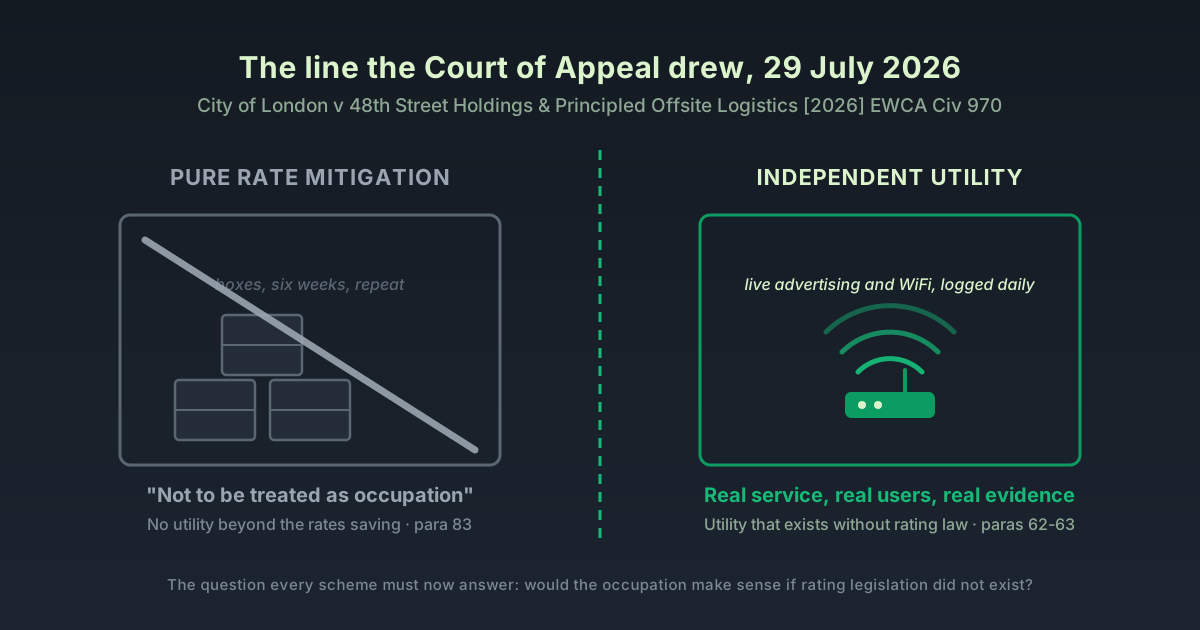
Lady Justice Falk, with Lord Justice Bean and Lord Justice Holgate agreeing, has now closed that door. The court’s conclusion, at paragraph 83 of the judgment, is that placing items in an empty building does not amount to occupation where three things are true: the sole aim is to generate occupation for the purposes of the reset rules, there is no commercial or business purpose except rate mitigation, and the occupation is “beneficial” only because of the claimed rates saving. The court gave this a name, “pure rate mitigation occupation”, and held that it is not occupation at all.
Paragraph 83, in one sentence: if the only utility of what is happening in the building is the rates saving itself, it is not occupation. The Court of Appeal declined to complete the circular argument.
The reasoning matters as much as the result. The court held that beneficial occupation, the third of the four classic ingredients of rateable occupation, requires the use of the building to have some utility, value or benefit independent of the rating legislation (paragraphs 62 and 63). Boxes of redundant paper sitting in an empty office have none: take the rates rules away and the exercise is pointless. The occupation was “beneficial” only by a circular argument, valuable because it saved rates, and saving rates only if it counted as occupation.
What the court did not decide
Read the headlines this week and you could believe every form of rates mitigation died on 29 July. Read the judgment and you find a court drawing a careful, deliberate line.
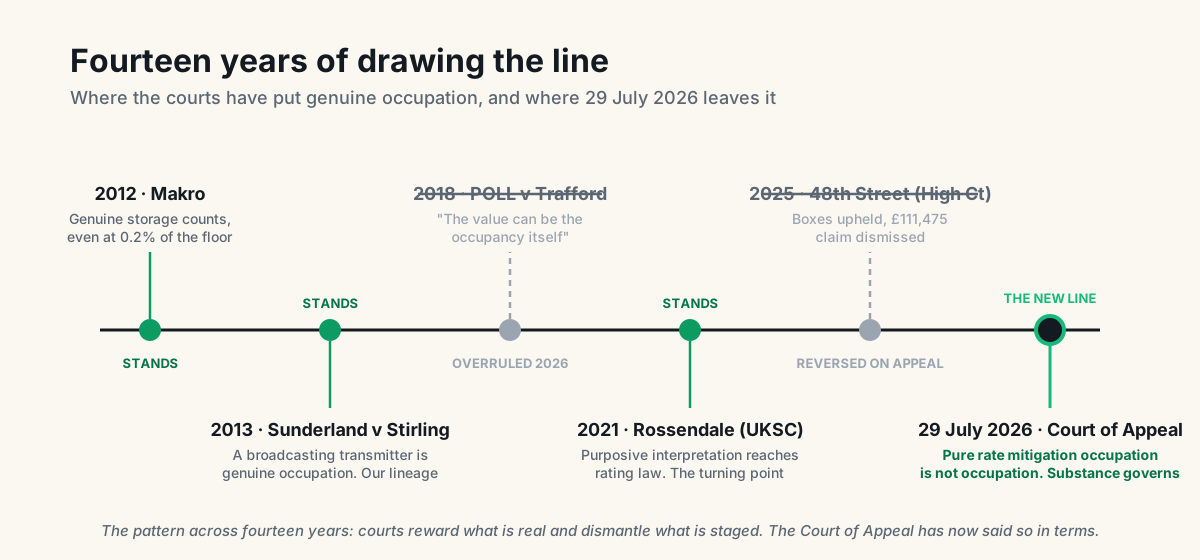
Three things are left standing. The second comes with a warning attached, and anyone selling you a scheme on the back of it should be quoting the warning too.
1. The four-part test remains the law
Actual, exclusive, beneficial and not too transient. The court has clarified the third limb, not rewritten the framework.
2. Genuine use was left alone here, but it was not blessed
The court did not overrule Makro v Nuneaton (2012), where the documents stored in an empty warehouse were records the occupier was legally required to keep, or PHE v Harlow (2021), where the files belonged to a public body that genuinely needed to retain them. But the reason is narrower than the headlines suggest: the City told the court it was not challenging those other forms of box-shifting scheme in this litigation. Falk LJ then added a pointed reservation. Under the Ramsay principle, a commercially irrelevant contingency inserted into a scheme to secure a fiscal advantage can be ignored, and whether that applies outside a tax context “will need to be considered in due course” (paragraph 82). Those schemes survived this case; they have not been declared safe. Separately, the old distinction between purpose and motive, “what a man does rather than why he does it”, is quoted with approval: where the activity has utility of its own, the fact that the owner’s motive was a rates saving does not undo it (paragraphs 28 and 67).
3. Active equipment delivering a real service remains on the right side
Sunderland v Stirling Investment Properties (2013), the case in which a marketing company’s Bluetooth transmitter, actively broadcasting in an otherwise empty warehouse, was held to be genuine rateable occupation, is untouched. The Court of Appeal describes it simply as “a different arrangement”, with not one word of criticism. Active equipment, delivering a real service, remains on the right side of the line.
A correction to our own archive
When the High Court upheld the 48th Street scheme in May 2025, we covered the ruling as the then-current statement of the law. It no longer is. That is how precedent works, and providers who built on the pure version of it now have a problem that no amount of paperwork will fix.
We asked for a substance test. This is one.
Regular readers will recognise the court’s logic, because it is the argument we have been making all year. In our July reform update we wrote that the answer to fakery was not a longer stopwatch but a rulebook that tests substance: real equipment, really operating, delivering a service with an economic purpose, continuously evidenced. Our submission to MHCLG argued for exactly that statutory test.
The Court of Appeal has now built one in common law. “Independent utility” is a substance test. It asks the only question that ever mattered:
For boxes of redundant paper, the answer is no, and they have gone accordingly. For snail farms and stage-set chapels, the answer has always been no, and the courts were dispatching those already. For a building hosting live, working technology that broadcasts a commercial service to the public every hour of its occupation, the answer is yes, and that is not an accident. It is what our model was built to be.
How our occupation answers the new question
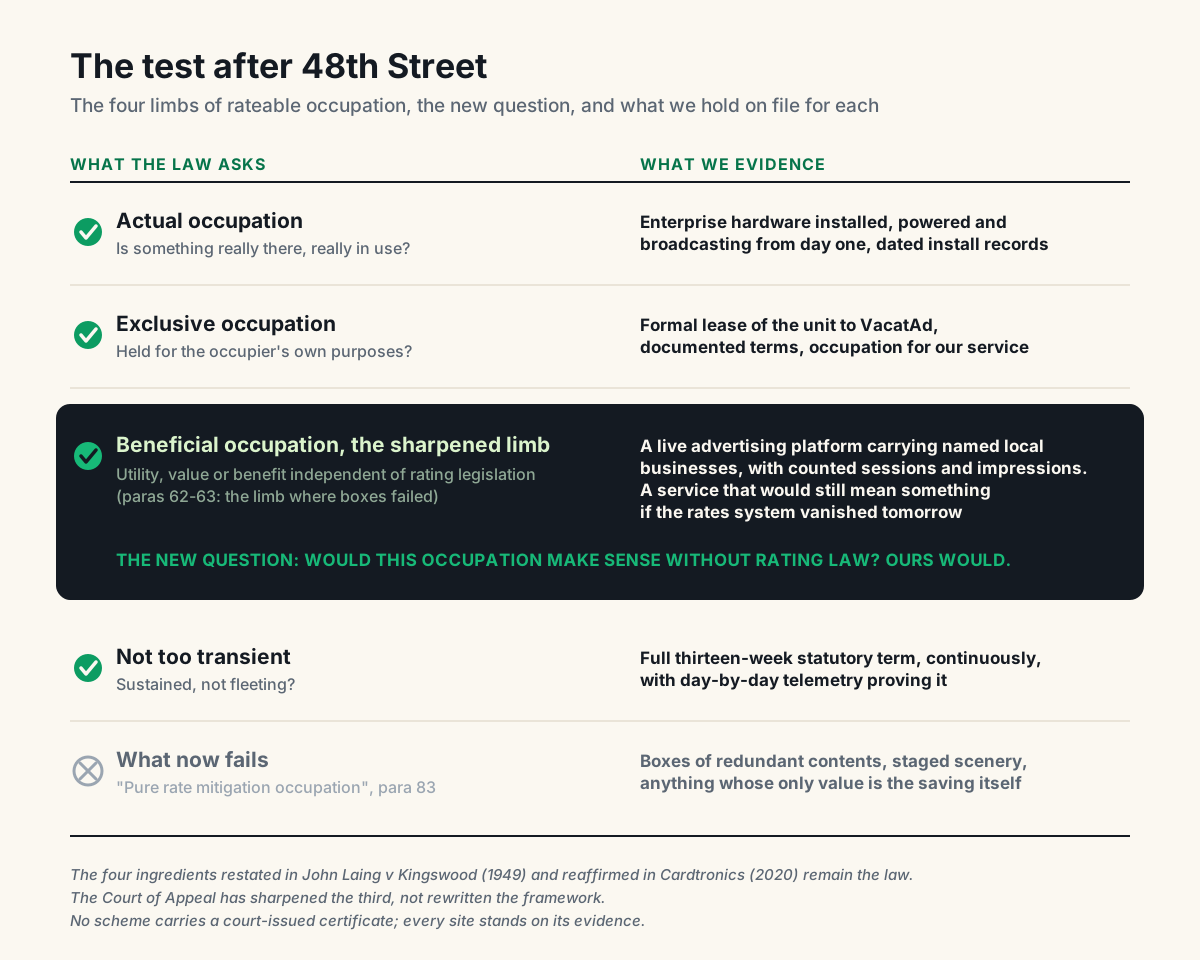
When VacatAd occupies a unit, we install enterprise-grade connectivity hardware that runs a live advertising and WiFi service, a captive portal promoting local small businesses to the people who connect to it. That is the business being conducted in the building, and it is a business that exists in its own right: advertising delivered over local wireless infrastructure did not begin with Empty Property Relief and would not end with it.
Held against the four limbs, and against the new question, this is how the model answers.
Actual occupation
Our equipment is physically installed, powered and broadcasting from the day the lease begins. Occupation of part of a building counts, as it always has; what matters is that the use is real, not notional.
Exclusive occupation
We occupy under a formal lease, on terms that give us the occupation for our purposes, properly documented.
Beneficial occupation, with independent utility
This is the limb the Court of Appeal has sharpened, and it is where boxes failed. Our answer is the service itself: a working advertising platform carrying real local businesses, delivering sessions and impressions we can count. The utility does not depend on rating law for its existence. Switch the rates system off tomorrow and a router broadcasting adverts to the public is still doing something; a box of redundant paper is not.
Not too transient
We occupy for the full statutory reset period, thirteen weeks in England, continuously, and our logs show it.
One thing we will not tell you: that any provider now carries a court-issued certificate of compliance. The Court of Appeal has not approved anyone’s scheme, ours included. What it has done is set the question every scheme must answer, and it is a question we have been answering, in evidence, on every site, since we started.
Evidence is the product now
Here is the practical consequence of the ruling, and it is the part most of the market is not ready for. The difference between mitigation that works and mitigation that fails is now provable substance. Councils will read this judgment as an invitation to ask harder questions, and they should. The schemes with nothing in the building will fail them. The providers with nothing on file will struggle to show otherwise.
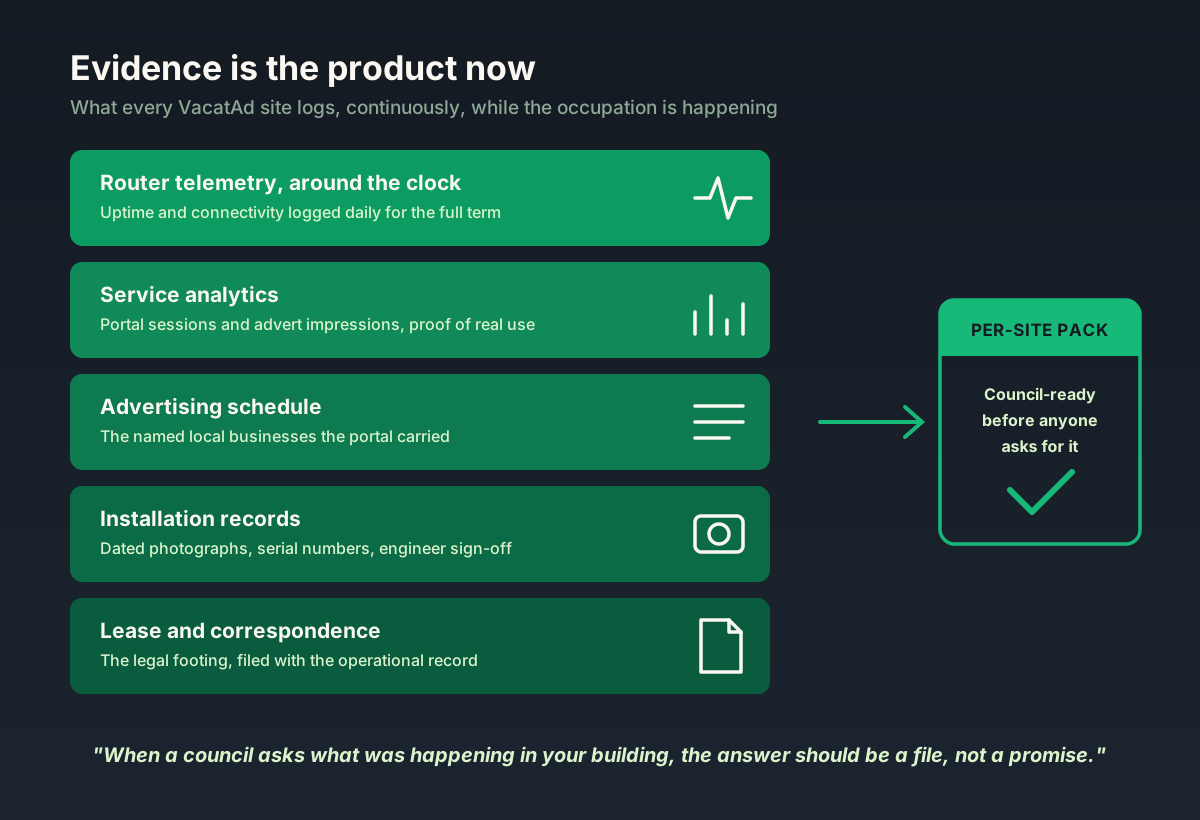
This is why our model has always been built around continuous, independent evidence, logged while the occupation is happening rather than reconstructed after a council asks.
Every VacatAd site generates router telemetry, uptime and connectivity logged around the clock to our monitoring platform, so there is a day-by-day record that the equipment was live for the full term, not just on the day someone photographed it. The captive portal produces service analytics, sessions and ad impressions showing the service was used, not merely available. Alongside those sit the advertising schedule, the named local businesses the portal carried; installation records, dated, photographed, with hardware serials; and the lease and correspondence for the site. For each property, that becomes a single evidence pack, assembled and ready before any billing authority asks for it.
What owners should do this week
The ruling is two days old, the headlines are blunt, and some of the letters landing on doormats over the coming months will be blunter. Three things are worth doing calmly and soon.
- Hold your current arrangement up against paragraph 83. Ask three questions of it. Is the occupation’s sole aim to generate a reset? Is there any commercial or business purpose beyond the rates saving? Is anything of value happening that does not depend on rating law? If your scheme is boxes by another name, it stopped working on 29 July, and because the court has declared what the law always was, past periods are not automatically safe either.
- Ask your provider for last month’s evidence. Not the brochure, the evidence: logs, analytics, anything continuous and independently generated. A photograph from installation day is not substance, and after this judgment it will not read as substance to a billing authority either.
- Price your position under the new reality. Our savings calculator will show you what your empty rates exposure looks like on the 2026 list, £48,000 a year on a £100,000 rateable value at the standard multiplier, and what genuine, evidenced occupation saves against it. Or call us on 0333 090 0443 and we will talk it through, including honestly telling you if what you have already is sound.
Two caveats belong in every version of this story. Principled may yet seek permission to appeal to the Supreme Court, and until any such application is resolved the Court of Appeal’s word is the law but perhaps not the last of it. And nothing here is legal advice; if you have historic schemes in the ground, take your own.
The market just got smaller, and better
A year ago we wrote about snail farms, stage-set shops and the House of Fakes, and we said the answer to fakery was a rulebook that tests substance. On 29 July, the Court of Appeal wrote one. The providers whose buildings contain nothing will leave the market. The ones whose buildings are genuinely working, and who can prove it hour by hour, will still be here.
We would rather be judged on what is happening inside the building. As of this week, everyone will be.
Source: The Mayor and Commonalty and Citizens of the City of London v 48th Street Holdings Ltd & Principled Offsite Logistics Ltd [2026] EWCA Civ 970, handed down 29 July 2026, on appeal from Charles Bagot KC sitting as a Deputy High Court Judge, [2026] EWHC 1130 (KB). The information in this piece is general guidance on UK business rates and is not tax, legal or valuation advice.
Ask for the evidence, not the brochure
Use the calculator to see your estimated empty-rates exposure on the 2026 list, or talk to us about whether your current mitigation would survive a substance test.
Try the calculator Get in touch